
Subject Guide
Could Actuarial Science Be the Right Path for You?
Actuarial Science combines mathematics, probability, statistics, finance and risk modelling to understand the financial impact of uncertain future events. It may suit students who enjoy analytical problem-solving, quantitative thinking and using evidence to support decisions.

Understanding Actuarial Science
What Does Actuarial Science Actually Involve?
Actuarial Science is the study of how mathematics, statistics, finance, and risk analysis can be used to understand uncertain future events and their financial impact.
Actuaries use quantitative methods to evaluate questions such as how much money organisations should set aside for future obligations, how risks can be measured, and how financial decisions can be made when outcomes are uncertain.
The subject combines mathematical modelling with real-world applications across areas such as insurance, pensions, investments, financial risk, and long-term planning.
Actuarial Science = Mathematics + Probability & Statistics + Finance/Economics + Risk Modelling + Professional Qualification Pathway

Subject Content
What Will You Study in Actuarial Science?
Actuarial Science brings together mathematics, statistics, finance and risk analysis to understand uncertain future outcomes. Students develop the quantitative foundations needed to analyse risk, build models and support financial decision-making.
The exact curriculum varies between universities, but most programmes include actuarial modelling, mathematics, probability and statistics, finance and economics, with computing and data analysis becoming increasingly common.
01
Mathematics & Statistics
Actuarial Science requires a strong foundation in mathematical and statistical thinking. Students commonly study areas such as calculus, linear algebra, probability theory, statistical inference and regression.
02
Actuarial Modelling
Students learn how mathematical models can represent uncertain events and financial outcomes, including areas such as life contingencies, survival models, loss models and risk theory.
03
Finance & Economics
Students develop knowledge of financial concepts such as interest theory, investment principles, corporate finance and economic factors that influence financial decisions.
04
Risk & Stochastic Modelling
Students explore how probability-based models can be used to analyse uncertainty, measure risk and understand possible future scenarios.
05
Computing & Data Analysis
Many programmes include programming, data analysis and predictive modelling to support modern actuarial work. The depth of computing content depends on the programme.
06
Professional & Communication Skills
Some programmes also include professional communication, ethics, teamwork, business context and practical projects.
Real-World Application
How Does Actuarial Science Help Solve Real Problems?
Actuarial Science applies mathematical models, statistical analysis and financial knowledge to help organisations understand uncertainty and make informed decisions.
Actuaries study possible future outcomes, evaluate financial risks and help organisations plan for obligations that may occur over many years.
Their work supports decisions across areas such as insurance, pensions, investments and broader risk management.
01
Insurance & Risk Assessment
How Can Actuarial Science Help Understand Risk?
Actuarial Science helps organisations analyse uncertain events by using mathematical models and statistical methods. This can support decisions such as estimating future financial obligations, evaluating potential losses, and understanding how different risks may affect long-term planning.
02
Long-Term Financial Planning
How Do Actuarial Models Support Future Planning?
Actuarial models help organisations estimate future financial needs by considering uncertainty over time. These methods are used in areas such as pensions, long-term commitments, and financial sustainability planning.
03
Investment & Financial Risk
How Does Actuarial Analysis Support Financial Decisions?
Actuarial analysis uses probability, statistics, and financial modelling to evaluate possible outcomes and understand risk. This helps organisations make more informed decisions when planning for uncertain financial situations.
Skills Development
What Skills Can You Build Through Actuarial Science?
Actuarial Science develops more than mathematical knowledge. Students learn how to analyse information, evaluate uncertainty and communicate evidence-based conclusions.
The subject combines technical skills with the ability to interpret complex situations and support decisions involving risk.
01
Analytical Thinking
How Do Actuarial Students Learn to Approach Complex Problems?
Students develop structured ways of breaking down complex problems, identifying relevant information and building logical solutions using mathematical and statistical methods.
02
Quantitative Problem Solving
How Does Actuarial Science Develop Mathematical Reasoning?
Students work with mathematical models, probability and statistics to analyse problems where outcomes may not be certain.
03
Risk & Probability Reasoning
How Do Students Learn to Work With Uncertainty?
Actuarial Science teaches students to use probability and evidence to evaluate possible outcomes rather than relying only on fixed answers.
04
Data Interpretation
How Is Data Used in Actuarial Decision-Making?
Students learn how to interpret quantitative information, identify patterns, and use data to support financial and risk-related analysis.
05
Financial Understanding
How Does Actuarial Science Connect Mathematics With Finance?
Students develop an understanding of financial concepts, including how economic and financial factors influence risk and long-term planning.
06
Communication Skills
Why Do Actuarial Professionals Need Communication Skills?
Actuarial work involves explaining technical analysis to people who may not have a mathematical background. Students develop skills to present findings clearly and effectively.
STUDENT FIT
Could Actuarial Science Match Your Interests and Strengths?
Actuarial Science can be a rewarding pathway for students who enjoy mathematics, analytical thinking, and solving complex problems using evidence and structured reasoning.
The subject also requires patience and commitment, as many actuarial careers involve continued professional learning beyond university.
May Suit Students Who…
Do You Enjoy Working With Numbers, Patterns and Uncertainty?
Actuarial Science may suit students who enjoy mathematics, probability and statistics, and who like exploring problems where the answer requires analysis rather than simple recall.
Do You Like Understanding Why Something Happens?
Students who prefer analysing information, identifying patterns and building logical explanations may find the subject engaging.
Are You Comfortable With Continuous Learning?
The actuarial pathway often involves professional development after university. Students should be prepared for ongoing learning and structured study.
Consider Carefully If…
Are You Choosing the Subject Mainly Because It Sounds Prestigious?
Actuarial Science requires genuine interest in quantitative work. Choosing the subject only because of perceived career outcomes may create challenges later.
Do You Prefer Subjects With Less Mathematical Focus?
Mathematics, probability, and statistics are central parts of actuarial education. Students who strongly dislike quantitative subjects may want to explore alternative pathways.
Do You Expect the Degree Alone to Complete the Professional Journey?
Completing a degree does not normally make someone a professionally qualified actuary. Professional requirements may continue after university.
Before Choosing Actuarial Science, Ask Yourself:
CAREER CONNECTIONS
Where Can Actuarial Science Lead?
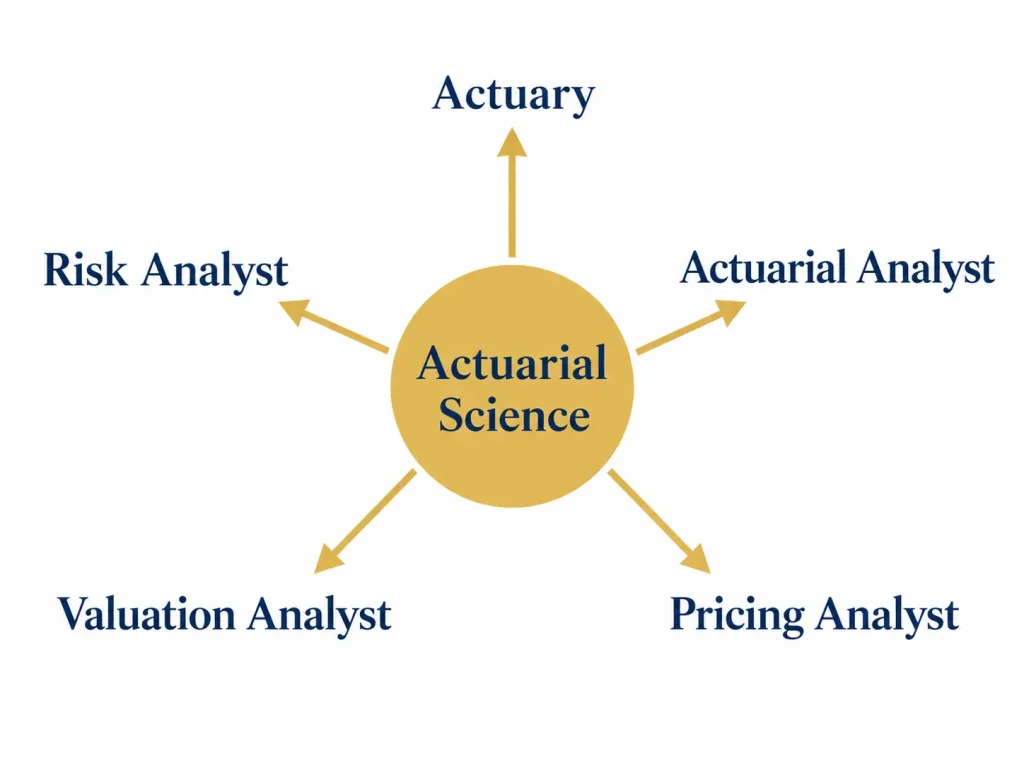
Actuarial Science can support careers that involve analysing uncertainty, evaluating financial risk and using evidence to support decisions.
Many graduates begin in analytical roles before progressing through professional qualification requirements and gaining experience in their chosen area.
The exact career pathway depends on the student’s interests, professional goals and the requirements of their intended industry or location.
EDUCATION PATHWAYS
How Can You Build Your Path Into Actuarial Careers?
Students can enter actuarial careers through different academic routes, depending on their previous education, career goals and the requirements of their intended pathway.
An Actuarial Science degree is one common route, but related quantitative backgrounds such as mathematics, statistics, economics, finance or other analytical disciplines may also provide relevant foundations for further actuarial study.
Undergraduate Actuarial Science Route
A Bachelor’s degree in Actuarial Science provides structured study in mathematics, probability, statistics, finance and actuarial modelling. It can prepare students for graduate-level analytical roles and further professional development.
Related Quantitative Backgrounds
Students from quantitative disciplines such as mathematics, statistics, economics, finance, econometrics or related fields may also develop relevant foundations for actuarial pathways.
The suitability of a background depends on the programme requirements and the professional pathway being considered.
Postgraduate Route
A postgraduate programme may support students who want to develop actuarial knowledge after completing another quantitative degree or who want to specialise further.
However, a Master’s degree is not normally required to begin mainstream actuarial employment.
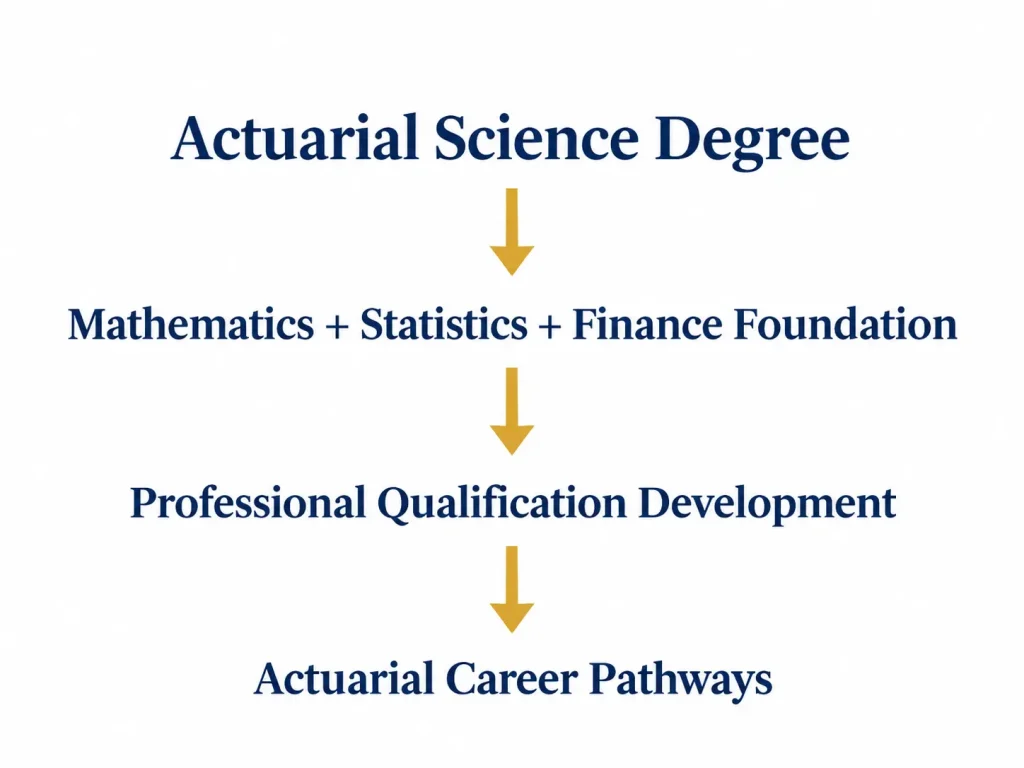
Degree Study Is One Step In The Professional Journey
Completing a university degree provides academic preparation, but professional qualification requirements are separate. Students should understand the additional requirements of their intended professional pathway before choosing a programme.
Professional Recognition
How Does Professional Recognition Work in Actuarial Science?
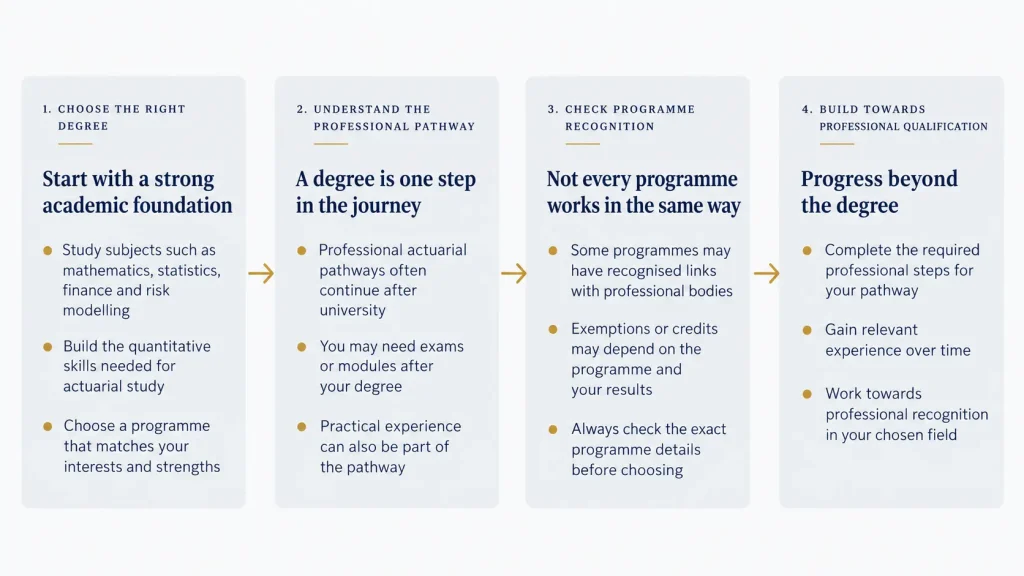
An Actuarial Science degree can provide the academic foundation needed to begin an actuarial pathway, but professional recognition usually involves additional requirements beyond university study.
Depending on the professional body, programme structure and student pathway, some university programmes may provide recognised exemptions or credits towards professional requirements. Students should verify the recognition status of the specific programme they are considering.
Before selecting a programme, students should consider:
UNIVERSITY PATHWAYS
How Can You Choose the Right Actuarial Science Programme?
Choosing an Actuarial Science programme involves more than comparing university names. Students should consider whether the programme structure, academic content and professional pathway support their individual goals.
A programme that suits one student may not suit another, depending on their preferred career direction, academic background and future plans.
What Should You Look For in a University Programme?
Programme Content
Students should review whether the programme covers important areas such as mathematics, statistics, actuarial modelling, finance and risk analysis.
The depth and structure of these subjects can vary between universities.
Professional Pathway Alignment
Students should check whether the programme has recognised links, exemptions or credits with relevant professional bodies where applicable.
Recognition arrangements should be verified for the specific programme, campus and cohort.
Learning Experience
Students can compare opportunities such as:
- practical projects,
- data analysis work,
- industry exposure,
- problem-solving activities.
These experiences may help students connect academic learning with real-world applications.
Entry Requirements
Mathematics is typically an important foundation for Actuarial Science study. Students should review the specific mathematics requirements, subject expectations and academic criteria for each programme.
The research notes that universities commonly emphasise Mathematics, while Further Mathematics, Statistics, Economics or Computer Science requirements vary by institution.
Programme Environment
Students may consider factors such as:
- teaching approach,
- academic support,
- location,
- opportunities for professional development,
- student experience.
COUNTRY FIT
How Can You Choose a Country for Actuarial Science Study?
The right study destination depends on more than the country name. Students should consider whether the education system, university programmes and professional environment support their intended actuarial pathway.
A country that suits one student may not suit another depending on academic goals, professional plans, budget and personal circumstances.
What Should You Consider When Comparing Countries?
Does the Country Support Your Intended Actuarial Pathway?
Students should understand how actuarial careers are structured in their chosen country, including the role of professional bodies, qualification pathways and industry expectations.
Professional requirements can differ between countries, so students should review the pathway connected with their intended career direction.
Are Suitable Actuarial Science Programmes Available?
Students should compare whether universities offer programmes that match their academic interests, curriculum expectations and professional goals.
The availability of Actuarial Science programmes and their structure can vary between countries and institutions.
How Does the Local Education System Connect With Professional Recognition?
Students should understand how university study connects with professional development in their chosen destination.
Recognition arrangements, exemptions, or credits should always be checked with official professional body and university sources.
Can You Plan the Full Cost of Your Study Journey?
Students should consider:
- tuition fees,
- living expenses,
- professional development costs,
- exchange-rate considerations,
- long-term financial planning.
A country decision should be based on the complete study pathway, not only the initial tuition fee.
Will the Learning Environment Support Your Goals?
Students may consider:
- academic culture,
- learning support,
- access to professional networks,
- lifestyle and personal preferences.
BUDGET PLANNING
What Should You Consider When Planning Your Actuarial Science Journey?
Planning for Actuarial Science involves looking beyond the cost of a university degree. Students and families should consider the full financial pathway, including academic study, living expenses and any additional professional development requirements connected with their intended career route.
The total cost will vary depending on the country, university, programme structure and individual circumstances.
What Costs Should You Consider?
University Costs
Students should compare tuition fees, programme duration and available funding options when evaluating Actuarial Science degrees.
The published cost of a programme should always be checked from the university’s official source because fees can change over time.
Living Expenses
Students should include expected living expenses such as accommodation, food, transport, insurance, and other personal costs when planning their study journey.
These costs vary significantly depending on location and lifestyle.
Professional Development Costs
Depending on the professional pathway, students may need to consider additional costs related to professional development, such as examinations, modules, memberships or other requirements.
Students should verify the current requirements of the relevant professional body.
Long-Term Financial Planning
A realistic plan should consider the full study journey, including tuition changes, exchange-rate movement, professional development and possible future academic or career-related expenses.
EXPLORE MORE
What Else Should You Know About This Field?
Choosing a subject is a major decision. Before deciding, it can help to explore more questions about the field, career possibilities, industry changes, and study options. Our insights provide additional information to help students and families understand the pathway more clearly.
COMMON QUESTIONS
What Do Students Often Ask About This Field?
Choosing a subject is an important decision. Students and families often have questions about what they will study, who this field may suit, and how it connects to future career options.
Is Actuarial Science only about insurance?
No. While insurance is one important area where actuarial methods are used, Actuarial Science also connects with areas such as pensions, investments, financial risk and long-term planning.
The subject focuses on understanding uncertainty and its financial impact using mathematics, statistics, finance and risk modelling.
Do I become a qualified actuary after completing an Actuarial Science degree?
Not automatically. An Actuarial Science degree provides academic preparation, but professional qualification usually involves additional requirements such as professional examinations, experience, and membership requirements depending on the relevant professional pathway.
Students should understand the requirements of their intended professional body before choosing a programme.
How much mathematics is involved in Actuarial Science?
Mathematics is a central part of Actuarial Science. Students commonly study areas such as calculus, probability, statistics, financial mathematics and mathematical modelling.
Students should review programme requirements carefully because the depth of mathematics can vary between universities.
What is the difference between Actuarial Science and Finance?
Both fields involve financial decision-making, but they focus on different areas.
Actuarial Science places stronger emphasis on mathematics, probability, statistics, and modelling uncertainty over time.
Finance focuses more broadly on areas such as investments, markets, corporate finance and financial management.
Should I choose a programme with professional recognition?
Students should check whether a programme aligns with their intended professional pathway and whether it has recognised arrangements with relevant professional bodies.
Recognition, exemptions or credits can vary depending on the professional body, programme, campus and cohort.
Can students from other quantitative backgrounds enter actuarial careers?
Yes, depending on the pathway. Backgrounds such as mathematics, statistics, economics, finance, econometrics and other quantitative fields may provide relevant foundations.
Students should review the requirements of their intended programme and professional pathway.
Is Actuarial Science suitable if I enjoy mathematics but not finance?
Actuarial Science includes financial concepts alongside mathematics and statistics. Students should consider whether they are interested in applying quantitative methods to financial and risk-related problems.
FIND YOUR PATH
Could Actuarial Science Be the Right Choice for You?
Choosing a subject is the beginning of a longer journey. Understanding your interests, academic strengths, and future goals can help you decide whether Actuarial Science matches your pathway.
Bay Scholars can help you explore your options and make informed decisions about subjects, universities, and future directions.