
CAREER DISCOVERY
Could a Career as an Actuary Be Right for You?
Actuaries use mathematics, statistics, data, and financial reasoning to understand uncertainty and help organisations make decisions about risk, future obligations, and financial outcomes. This career may suit students who enjoy analytical problem-solving, quantitative thinking, and working with complex information.

THE WORK
What Does an Actuary Actually Do?
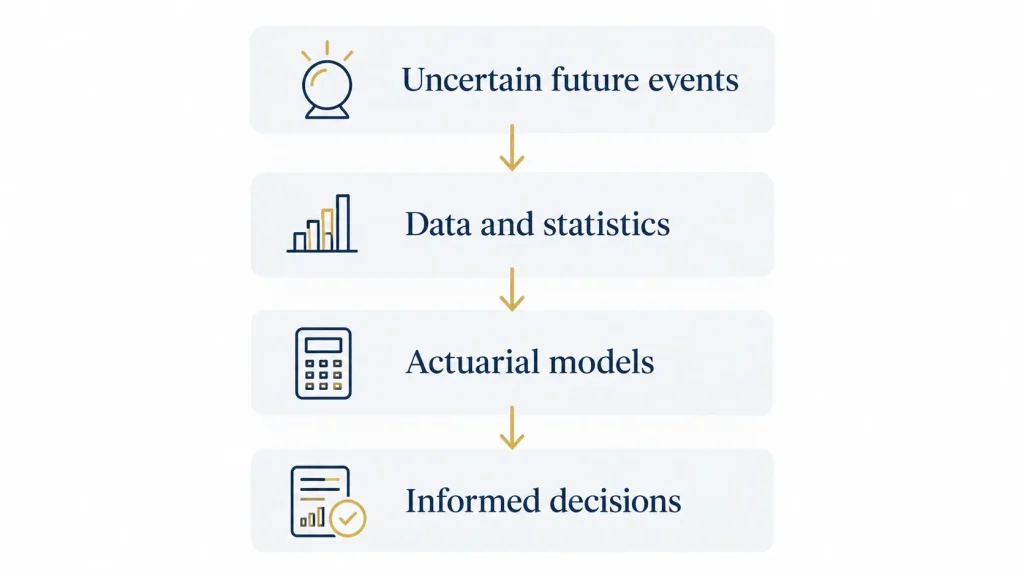
Actuaries help organisations make decisions when the future is uncertain. They combine mathematics, statistics, financial knowledge, and data analysis to understand possible outcomes and evaluate their potential impact.
Their work involves studying patterns, building models, and communicating insights that help organisations prepare for financial risks and long-term decisions.
Analyse Risk
How Do Actuaries Understand Uncertainty?
Actuaries analyse data and patterns to estimate the likelihood and potential impact of future events. This helps organisations understand possible risks before making important decisions.
Build Models
How Do Actuaries Use Mathematics to Explore Future Outcomes?
Actuaries create mathematical and statistical models to represent possible scenarios and estimate how uncertain events may affect individuals, organisations, or financial plans.
Evaluate Financial Impact
How Do Actuaries Assess Long-Term Financial Effects?
Actuaries examine how uncertainty may influence costs, liabilities, investments, and future financial obligations.
Support Decisions
How Do Actuaries Help Organisations Plan?
Actuaries communicate their findings to help decision-makers understand risks, compare options, and make informed choices.
PROBLEMS THEY SOLVE
What Problems Do Actuaries Help Solve?
Organisations often need to make decisions about situations where the future cannot be predicted with certainty.
Actuaries help analyse possible outcomes, estimate financial consequences and develop models that support long-term planning.
How Do Actuaries Estimate What May Happen?
Actuaries use mathematics, statistics and data analysis to estimate the probability of future events and understand how different scenarios may develop.
Examples may include changes in claims, financial losses or other uncertain outcomes.
What Could an Uncertain Event Cost?
Actuaries evaluate how future events may affect financial obligations, costs and resources.
Their analysis helps organisations prepare for possible financial outcomes.
How Can Organisations Prepare for Uncertainty?
Actuaries help organisations compare different scenarios and make plans that consider possible future conditions.
This is important for decisions involving long-term commitments and financial planning.
How Do Actuaries Support Better Decisions?
Actuarial analysis helps organisations understand both potential risks and possible opportunities when making complex decisions.
Day-to-Day Work
What Does an Actuary Do?
An actuary’s work combines analysis, modelling and communication. While specific responsibilities vary by industry and role, many actuaries spend their time understanding data, evaluating possible outcomes, and explaining what the results mean for decision-makers.
Analyse Data
How Do Actuaries Find Patterns in Information?
Actuaries review historical data, trends, and statistical information to understand possible risks and future scenarios.
They use evidence to identify patterns that may influence financial decisions.
Develop Models
How Do Actuaries Model Possible Futures?
Actuaries create mathematical and statistical models to represent uncertain situations and estimate how different outcomes may affect organisations.
Interpret Results
How Do Actuaries Turn Analysis Into Insights?
Actuaries evaluate model results, consider assumptions, and explain what the findings may mean for financial planning, risk management, or business decisions.
Communicate Findings
Why Do Actuaries Need Communication Skills?
Actuaries often explain complex analysis to people who may not have a technical background. Clear communication helps organisations understand risks and make informed decisions.
SKILLS & STRENGTHS
What Skills May Help in Actuarial Work?
Actuarial work combines mathematical analysis, problem-solving and communication. Students who enjoy working with numbers, exploring complex questions, and understanding uncertainty may find these skills valuable in an actuarial pathway.
Different roles may require different strengths, and these abilities can continue to develop through education and professional experience.
Analytical Thinking
How Do Actuaries Approach Complex Problems?
Actuaries break down complex situations, examine evidence, and use structured reasoning to understand possible outcomes.
Quantitative Skills
Why Are Mathematics and Statistics Important?
Actuarial work relies on mathematical and statistical methods to analyse uncertainty, build models, and evaluate potential outcomes.
Problem Solving
How Do Actuaries Find Solutions Under Uncertainty?
Actuaries consider different scenarios, evaluate possible impacts, and develop approaches to help organisations make informed decisions.
Attention to Detail
Why Does Accuracy Matter in Actuarial Work?
Small assumptions or changes in data can affect analysis. Careful review helps actuaries produce reliable models and conclusions.
Communication
Why Do Actuaries Need to Explain Complex Ideas?
Actuaries often communicate technical findings to decision-makers who may not have a mathematical background.
Continuous Learning
Why Is Ongoing Development Important?
Actuarial careers involve continued learning as professional requirements, analytical methods, and industries develop.

Career Fit
Could a Career as an Actuary Suit You?
A career as an actuary may suit students who enjoy analytical work, structured problem-solving, and thinking carefully about uncertain future outcomes.
It can also require patience and persistence, because actuarial work often involves detailed analysis, careful communication and continued professional development over time.
May Suit Students Who…
Do You Enjoy Working With Numbers and Patterns?
Actuarial work may suit students who are comfortable with mathematics, statistics and quantitative reasoning, and who enjoy understanding how numbers can support real decisions.
Do You Like Solving Complex Problems Step by Step?
Students who enjoy breaking complex questions into smaller parts and working through them logically may find actuarial work engaging.
Are You Curious About Risk, Uncertainty and Future Outcomes?
Actuarial work often focuses on questions where the future is uncertain. Students who enjoy thinking about possible scenarios and their consequences may find this career meaningful.
Are You Comfortable With Continuous Learning?
The actuarial pathway often continues beyond university through professional development and ongoing learning. Students should be prepared for a long-term commitment to growth.
Consider Carefully If…
Do You Strongly Dislike Mathematics or Statistics?
Mathematics and quantitative reasoning are central to actuarial work. Students who strongly dislike this type of work may want to explore related careers that are less mathematically focused.
Do You Prefer Fast Decisions Over Careful Analysis?
Actuarial work often involves careful modelling, checking assumptions, and reviewing details. Students who prefer less structured or less analytical work may find the role less appealing.
Are You Looking for a Career With Minimal Ongoing Study?
Professional development is a common part of actuarial pathways. Students who want a role without continued learning requirements should consider this carefully before choosing the profession.
Before Exploring This Career Further, Ask Yourself:
Related Subjects
Which Subjects Can Lead Toward Actuarial Work?
There is more than one academic route that can support a future actuarial career. The most relevant subjects usually develop strong foundations in mathematics, statistics, financial thinking, and analytical problem-solving.
The best choice depends on your academic background, university options, and intended professional pathway.
Actuarial Science
How Does This Subject Prepare Students for Actuarial Work?
Actuarial Science provides direct exposure to areas such as probability, statistics, financial mathematics, risk analysis, and actuarial modelling.
It is a specialised pathway designed around actuarial concepts and applications.
Explore Actuarial Science Subject Guide →
Mathematics
How Can Mathematics Support an Actuarial Pathway?
Mathematics develops strong foundations in quantitative reasoning, modelling and problem-solving that can support further actuarial study and professional development.
Statistics
Why Is Statistics Relevant to Actuarial Work?
Statistics helps students understand probability, data analysis, and evidence-based decision-making, which are important parts of actuarial analysis.
Economics & Finance
How Do Finance and Economics Connect With Actuarial Work?
Economics and finance can help students understand markets, financial systems, and decision-making. When combined with strong quantitative skills, these subjects can support actuarial-related pathways.

Education Pathway
How Can You Prepare for an Actuarial Career?
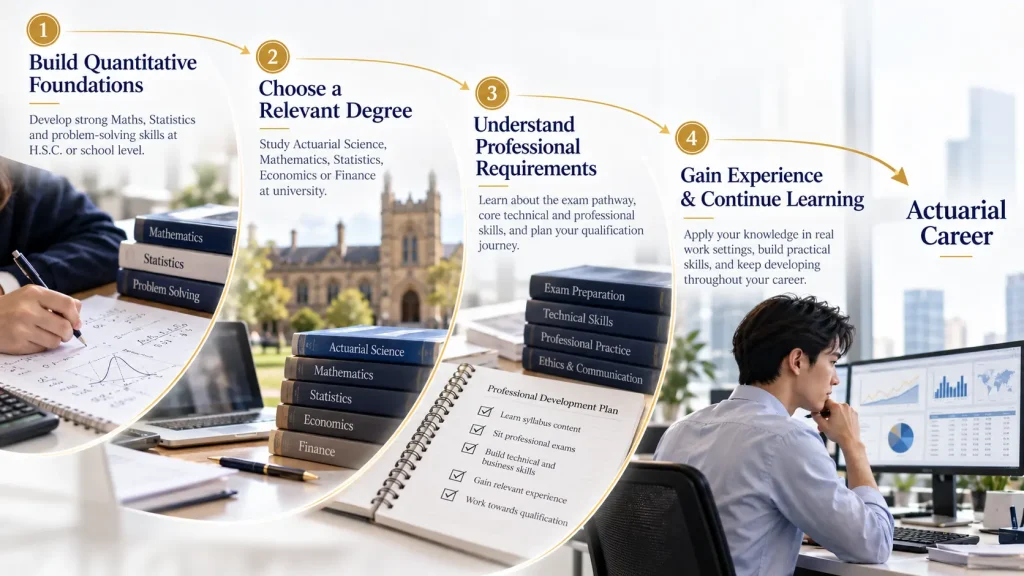
There is more than one route into actuarial work. Students usually begin by developing strong foundations in mathematics, statistics, and analytical thinking before choosing a university pathway that supports their career goals.
The exact route depends on the country, university, professional body and the type of actuarial work a student wants to pursue.
Build Quantitative Foundations
Why Are Mathematics and Statistics Important?
Actuarial work relies heavily on quantitative analysis. Students can prepare by developing confidence in areas such as mathematics, probability, statistics, and problem-solving.
Choose a Relevant Degree Path
Which University Subjects Can Support an Actuarial Career?
Students may study Actuarial Science or related quantitative subjects such as Mathematics, Statistics, Economics, or Finance.
The most suitable choice depends on academic interests, university options, and intended professional pathway.
Understand Professional Requirements
What Happens After University Study?
Professional actuarial pathways vary by country and professional body. Students should understand whether further examinations, modules, experience, or membership requirements apply to their intended pathway.
Gain Experience and Continue Learning
How Does Professional Development Continue?
Actuarial careers often involve continued learning after graduation. Students may develop through professional study, workplace experience, and specialist knowledge in their chosen area.
Professional Recognition
How Does Actuarial Qualification Work?
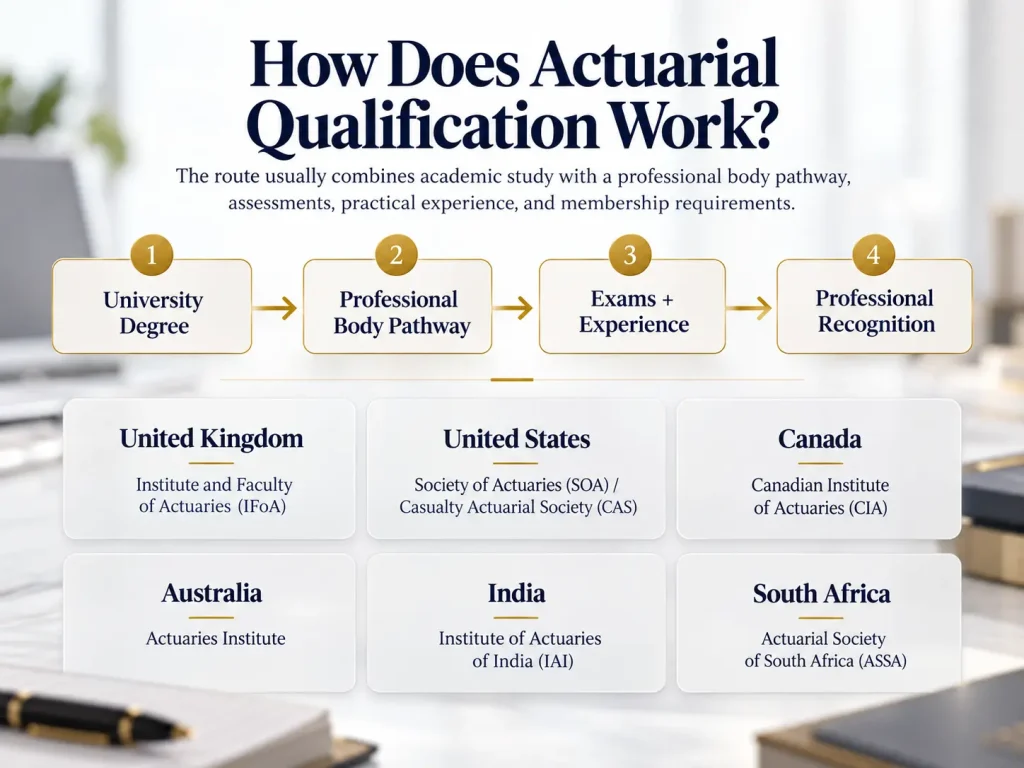
An Actuarial Science degree can provide important academic foundations, but becoming a professionally recognised actuary usually involves additional steps beyond university study.
The requirements depend on the professional body, country, and pathway selected. Students should understand these requirements before choosing a programme.
University Degree
What Does Academic Study Provide?
A university degree can help students develop knowledge in areas such as mathematics, statistics, finance, probability and actuarial modelling.
Some programmes may also have recognised arrangements with professional bodies.
Professional Body Pathway
What Happens After Academic Study?
Professional actuarial organisations set their own requirements for qualification. These may involve examinations, modules, practical experience and membership requirements.
Exams and Experience
Why Are Additional Steps Required?
Professional pathways are designed to ensure that future actuaries develop both technical knowledge and the practical ability to apply that knowledge in professional settings.
Recognition and Membership
What Should Students Verify Before Choosing a Programme?
Students should check whether a specific programme has recognised arrangements with relevant professional bodies and understand what conditions apply.
Recognition may vary depending on:
Career Directions
Where Can Actuaries Apply Their Skills?
Actuarial skills can be applied across different industries where organisations need to understand uncertainty, evaluate risk and make long-term decisions.
The exact role of an actuary can vary depending on the industry, organisation and professional pathway.
Insurance
How Do Actuaries Support Insurance Decisions?
Actuaries help analyse uncertainty related to insurance products, including estimating risks, evaluating potential costs and supporting pricing or financial planning decisions.
Pensions & Retirement
How Do Actuaries Support Long-Term Financial Planning?
Actuaries help organisations understand long-term financial commitments related to retirement plans and future obligations.
Investment & Asset Management
How Do Actuaries Analyse Financial Risks?
Actuaries may apply their analytical skills to evaluate investment risks, financial models, and long-term scenarios.
Risk Management
How Do Actuaries Help Organisations Prepare for Uncertainty?
Actuaries use data analysis and modelling approaches to help organisations understand potential risks and consider different future outcomes.
Consulting
How Do Actuaries Support Different Organisations?
Actuarial consultants apply their technical knowledge to help clients analyse financial risks, review strategies and make informed decisions.
Data & Analytics
How Are Actuarial Skills Used Beyond Traditional Roles?
The analytical skills developed through actuarial training can also support roles involving data interpretation, modelling and evidence-based decision-making.
Related Careers
Actuarial work develops skills in mathematics, statistics, modelling and analytical problem-solving. Students interested in similar skills may also explore related quantitative careers.
Risk Analyst
Analyses uncertainty and evaluates potential risks to support organisational decisions.
Financial Analyst
Uses financial information and analysis to support investment and business decisions.
Data Analyst
Interprets datasets, identifies patterns and supports evidence-based decision-making.
Statistician
Uses statistical methods to analyse data, identify trends, and understand uncertainty.

CAREER INSIGHTS
Explore Actuarial Work in More Depth
Go beyond the job title with practical guides that explain actuarial work, related subjects, and the decisions students should consider before choosing this pathway.
What Does an Actuary Actually Do?
A deeper look at the problems actuaries solve, the industries they work in, and how they use their analytical skills.
Is Actuarial Science Right for You?
Explore what studying Actuarial Science involves, the skills it develops, and who may enjoy the subject.
Actuarial Science vs Mathematics vs Finance
Compare three different academic routes and understand how they can connect to actuarial and related careers.
Frequently Asked Questions
Questions Students Often Ask About Actuarial Careers
What does an actuary do?
Actuaries use mathematics, statistics, data analysis, and financial reasoning to understand uncertainty and support decisions about risk and future financial outcomes.
They analyse information, develop models and communicate insights that help organisations prepare for different scenarios.
Is an Actuarial Science degree required to become an actuary?
An Actuarial Science degree is one possible pathway, but it is not the only academic route.
Related quantitative subjects such as Mathematics, Statistics, Economics and Finance may also provide relevant foundations. The most suitable pathway depends on the university, country and intended professional qualification route.
Does completing an Actuarial Science degree make someone a qualified actuary?
Not automatically.
A university degree can provide academic foundations, but professional qualification usually involves additional requirements set by relevant professional bodies. These may include examinations, modules, practical experience and membership requirements.
Is actuarial work only related to insurance?
No.
Insurance is one important area where actuaries work, but actuarial skills can also be applied in areas such as pensions and retirement, investment, risk management, consulting and data-related work.
What subjects are useful for becoming an actuary?
Subjects that develop strong quantitative and analytical foundations can support an actuarial pathway.
These may include:
Actuarial Science, Mathematics, Statistics, Economics, and Finance.
The right choice depends on a student’s academic background and future goals.
How much mathematics is involved in actuarial work?
Mathematics is an important part of actuarial work. Actuaries commonly use areas such as probability, statistics, financial mathematics and modelling to analyse uncertainty.
Students should consider whether they enjoy quantitative problem-solving before choosing this pathway.
Are actuarial professional requirements the same in every country?
No.
Professional requirements can vary depending on the country and professional body. Students should check the requirements of their intended pathway, including examinations, recognition arrangements and experience requirements.
What skills may help someone become an actuary?
Actuarial work may suit students who enjoy analytical thinking, mathematics, problem-solving and working with complex information.
Communication skills and a willingness to continue learning are also important because actuaries often explain technical analysis and continue developing professionally.
NEED GUIDANCE?
Could Actuarial Work Be the Right Path for You?
Choosing a career pathway starts with understanding yourself — your interests, strengths and future goals.
If you enjoy mathematics, analytical thinking and exploring how decisions can be made under uncertainty, actuarial work may be a pathway worth exploring.
Bay Scholars can help you understand suitable subjects, university options and education pathways based on your individual profile.
Explore your pathway based on your interests, strengths and goals.